Home / Slab species
ReferenceBest wood for slab tables and countertops: species compared
SlabHome editorial team · Last reviewed October 2026
The best wood for a slab table or countertop is the one whose look you want, whose movement the room can live with and whose price fits the project. Hardness is only one of those three. This page puts the common slab species side by side, with figures from the USDA Wood Handbook and the Wood Database, so the choice can start from the look and end with the numbers.
Slab species at a glance
| Species | Look in a room | Janka hardness, lbf | Density, kg/m3 | Tangential shrinkage, % | Single slab width | Price tier |
|---|---|---|---|---|---|---|
| Black walnut (Juglans nigra) | Chocolate to purple brown heartwood, cream sapwood | 1,010 | 610 | 7.8 | Wide slabs available, rare above about 1000 mm | High |
| White oak (Quercus alba) | Light to mid tan, ray fleck on quarter sawn faces | 1,360 | 755 | 10.5 | Wide slabs from large trees | Medium to high |
| European oak (Quercus robur) | Light tan, warm under oil, pronounced grain | 1,120 | 675 | 8.4 | Wide slabs from large trees | Medium to high |
| Hard maple (Acer saccharum) | Creamy white, fine closed grain | 1,450 | 705 | 9.9 | Usually glued tops | Medium |
| Black cherry (Prunus serotina) | Pink brown, darkens to red brown with light | 950 | about 560 | 7.1 | Mostly boards and glued tops | Medium to high |
| White ash (Fraxinus americana) | Pale, open grain like oak | 1,320 | about 670 | 7.8 | Boards and glued tops | Medium |
| Teak (Tectona grandis) | Golden brown, oily feel, darkens with age | 1,000 to 1,070 | 655 | 5.8 | Plantation boards narrow, old stock wide | Very high |
| Monkey pod (Samanea saman) | Golden to dark brown heart, pale sapwood, wild grain | 900 | 600 | 3.4 | Very wide single slabs | Medium to high |
| Acacia, mangium (Acacia mangium) | Golden to mid brown, pale sapwood | 1,430 | 585 | 7.8 | Plantation boards, glued tops | Low to medium |
| Rubberwood (Hevea brasiliensis) | Pale cream to light tan, even | 960 | 595 | 5.1 | Glued tops from narrow boards | Low |
Janka (side hardness at 12% moisture content): Wood Handbook Tables 5-3b and 5-5b for walnut, white oak, maple, cherry, ash and teak (1,000 lbf), the Wood Database for the others and for teak (1,070 lbf). Density: average dried weight at 12% from the Wood Database; cherry and ash calculated from the Wood Handbook specific gravity at 12%. Shrinkage: green to ovendry, Wood Handbook Tables 4-3 and 4-4, the Wood Database for European oak, monkey pod and mangium. Price tier is a typical relative position and varies by market and slab size.
Start with the look
Most buyers choose a slab from a photo, and the photo shows colour and figure long before it shows hardness.
- Dark and rich. Black walnut is the reference. Its pale sapwood band along a live edge is part of the look. Darker slabs come from heartwood, and steaming evens out the colour of commercial walnut lumber, so ask whether a slab was steamed. See the walnut slab page.
- Light and calm. Hard maple and rubberwood are the palest, with fine, even grain. White and European oak are light with a stronger grain and, on quarter sawn faces, silver ray fleck. Ash looks like a paler oak.
- Warm and golden. Teak, acacia and monkey pod sit in the gold to mid brown range. Teak is the most even, acacia the most varied from board to board, monkey pod the wildest in figure. See the acacia slab page.
- Changes with light. Cherry darkens noticeably in the first months. Walnut lightens slightly toward a warmer brown. Teak deepens. Ask for photos of a finished piece that has been in light for a while, not only freshly sanded wood.
Then check how it moves
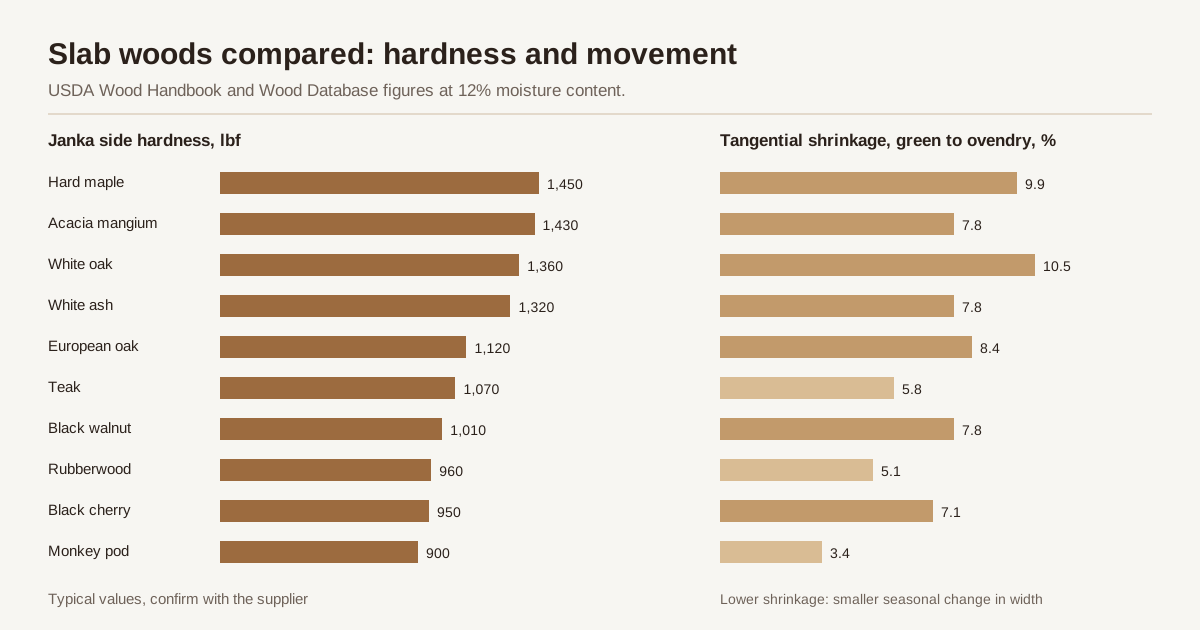
All wood swells and shrinks across its grain as indoor humidity changes. The tangential figure in the table is the shrinkage from green to ovendry on the flat sawn face: the larger it is, the more a wide top changes width between summer and winter.
| Movement group | Species | What it means for a top |
|---|---|---|
| Low | Monkey pod, teak, rubberwood | Wide single slabs and tops near windows cope better |
| Medium | Walnut, cherry, ash, mangium, European oak | The normal case: allow movement in fixings and gaps |
| Higher | White oak, hard maple | Wide flat sawn tops need generous slots and gaps; quarter sawn stock moves less |
The ratio between tangential and radial shrinkage also matters. A high ratio (white oak about 1.9, rubberwood about 2.2) means the slab moves unevenly across its faces and is more inclined to cup if it dries on one side. The wood movement calculator works out the change in width for a given species, width and moisture change, using the Wood Handbook method.
Hardness: what the Janka number does and does not tell you
The Janka test presses a steel ball 11.28 mm in diameter half way into the side of a board and records the force, in pounds force (lbf) or newtons. It predicts how easily a surface dents. It does not predict scratch resistance of the finish, stability or how a top ages.
For tables and counters, a practical reading:
- Below about 1,000 lbf (rubberwood, monkey pod, cherry, walnut): dents from dropped objects show. Under a good finish, a normal family table wears well.
- About 1,000 to 1,400 lbf (teak, European oak, ash, white oak): a little more forgiving.
- Above about 1,400 lbf (hard maple, mangium): the most dent resistant here, which is why maple is the classic chopping surface.
What the rubberwood hardness figure means in practice is set out in rubberwood Janka hardness.
Slab widths: where single slabs come from
| Source of the log | Species | Width you can expect |
|---|---|---|
| Large, older trees | Walnut, oak, monkey pod, old teak | Single slabs of 700 to 1000 mm and more, priced as unique pieces |
| Plantation trees | Rubberwood, acacia, plantation teak | Narrow boards, wide tops glued from several pieces |
| Urban and orchard trees | Walnut, monkey pod, other street trees | Wide and characterful, more defects and metal risk |
Monkey pod trees spread wide with short trunks, which is why very wide slabs of this species reach the market. Plantation species are harvested young, so a 900 mm top is a glued panel with a natural edge profile, not a cross section of the trunk. That is not a flaw: a good glued top can be more stable than a single wide slab. The types of wood slabs and countertops page explains how each construction behaves.
Durability and wet areas
None of these species should stand in water, and every countertop needs a finish on all faces. Teak is the most resistant to moisture and decay of the group, which is why it is used outdoors and on boats. Rubberwood has no natural durability outdoors and is an interior wood. White and European oak heartwood resist decay well, but oak reacts with iron and water to form blue black stains, so keep cast iron and steel wool off an oak top. Care routines are on the wood countertop care page.
Legal origin and paperwork
Wood crossing a border often needs its genus, species and country of harvest declared, and some species are listed under CITES. Bigleaf mahogany (Swietenia macrophylla) and many rosewoods are listed, while the species in the table above are not CITES listed at the time of writing. Check the current listing in the CITES checklist for anything exotic. Ask the workshop for the botanical name and origin of the timber in writing. The import pages for the United States and Australia set out what is asked as of October 2026.
Price tier: what drives it
Species is one driver of price among several: the width and thickness of the slab, the share of clear wood, how the slab was dried and how much flattening and filling it needs. A wide walnut or monkey pod slab is priced as a unique piece. A rubberwood or acacia top is priced by area and thickness. The guide to live edge slab cost breaks down each factor.
Choosing: a short path
- Pick the colour family from photos: dark, light or golden.
- Check movement for the room: wide tops near windows or heating favour low movement species.
- Check hardness for the use: chopping and heavy use favour maple, oak or mangium.
- Check width: a single slab wider than about 900 mm points to walnut, oak or monkey pod.
- Fix the budget: plantation species for glued tops, large tree species for single slabs.
Hevea (rubberwood) in depth, with its grades and treatment, is on the wood species page, and comparisons are in acacia vs rubberwood and teak vs rubberwood. When you know the look, send a request with the species or a reference photo. Matched workshops reply with photos of the actual slab.
Frequently asked questions
What is the best wood for a slab dining table?
There is no single best. Walnut is the classic for colour and figure, white oak for a light, hard wearing top, monkey pod for very wide single slabs that move little, and teak where the table may face humidity. Choose from the look you want first, then check hardness, movement and price.
Is a harder wood always better for a table top?
No. Hardness, measured by the Janka test, says how easily the surface dents. Most daily wear on a table is taken by the finish, and a stable, well dried slab matters more than a few hundred lbf of hardness. Black walnut at about 1,010 lbf is one of the most used table woods.
Which wood moves the least with humidity?
Of the species on this page, monkey pod, teak and rubberwood have the lowest tangential shrinkage, about 3.4 to 5.8%, against 9.9 to 10.5% for hard maple and white oak. Lower shrinkage means smaller seasonal changes in width, which helps wide slabs and tops near a window or a heat source.
Why are some species sold only as glued tops, not single slabs?
Because plantation trees such as rubberwood and many acacias are harvested young and slim. Their boards are narrow, so wide tops are glued from several pieces. Species from large old trees, such as walnut, oak and monkey pod, can still give single slabs wider than 900 mm, at a price.
Does SlabHome stock these species?
No. SlabHome is a free matching service. You name the species, or ask for suggestions, and up to 3 workshops that work it reply with photos of the actual slab and a quote.
Sources
- USDA Forest Products Laboratory, Wood Handbook FPL-GTR-282 (2021), chapter 4, Tables 4-3 and 4-4 (shrinkage)
- USDA Forest Products Laboratory, Wood Handbook FPL-GTR-282 (2021), chapter 5, Tables 5-3b and 5-5b (specific gravity, side hardness)
- The Wood Database: black walnut
- The Wood Database: English oak (European oak)
- The Wood Database: white oak
- The Wood Database: hard maple
- The Wood Database: teak
- The Wood Database: monkeypod
- The Wood Database: rubberwood
- The Wood Database: mangium (Acacia mangium)
- CITES: the CITES species checklist
Last reviewed October 2026. Figures are typical values from the sources named above, never a promise for one piece.
Describe the top you want
Size, species, style, finish and where it is going. SlabHome matches you with up to 3 workshops that reply with photos of the actual piece and a quote. Free for buyers, reply within 24 business hours.