Home / Countertop styles
ReferenceTypes of wood slabs and countertops: how each style looks, moves and costs
SlabHome editorial team · Last reviewed October 2026
There are nine common ways to turn a tree into a table or a counter top. Some keep the log as one wide piece, some glue it back together from strips or blocks, and some add resin. Each one looks different in a room, moves differently through the year and costs a different amount of labour.
The nine styles at a glance
| Style | How it is built | What you see in the room | Movement across the width | Typical thickness | Relative price |
|---|---|---|---|---|---|
| Live edge slab | One wide board cut through the log, natural edge kept | One tree, the outline of the trunk on one or both sides | High | 38 to 75 mm | High |
| Bookmatched pair | Two sequential slabs opened like a book and glued at the centre | A mirrored figure along a centre seam | High, two boards | 38 to 75 mm | High to very high |
| Cookie (cross cut) | A round or oval cut across the trunk | Growth rings, end grain on top | Radial cracks are common | 50 to 100 mm | Medium |
| Plank top | Three to six wide boards glued edge to edge | Wide boards with a few long seams, farmhouse look | Medium to high | 26 to 50 mm | Medium |
| Edge grain, full stave | Narrow strips running the full length, glued side by side | Long straight lines, calm surface | Low | 26 to 50 mm | Medium |
| Edge grain, finger joint | Narrow strips made of short pieces joined end to end | Strips with small zigzag joints | Low | 20 to 40 mm | Low |
| End grain | Short blocks stood on end, like a chessboard | Checkerboard or brick pattern of growth rings | Low, but the top is thicker | 50 to 100 mm | High |
| Face grain wide board | One wide face of a board, no glue line where possible | Cathedral figure of the flat sawn face | High | 26 to 50 mm | Medium |
| River top | Slabs with a channel of cast resin between them | Wood edges along a band of clear or coloured epoxy | Wood moves, resin does not | 38 to 60 mm | Very high |
Typical ranges. A workshop confirms its own limits for each species and size.
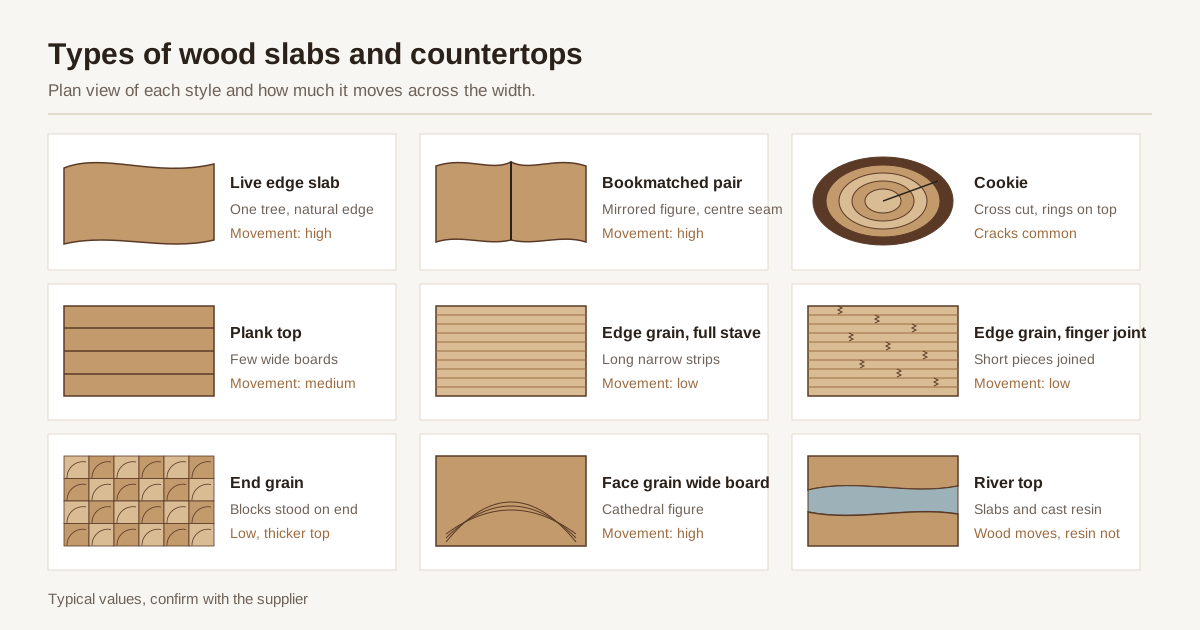
Three families: one tree, many strips, wood and resin
The nine styles sort into three families, and the family decides most of what follows: price, stability, how big the top can be and how it is cared for.
One tree. Live edge slabs, bookmatched pairs, cookies and wide face boards are cut through the log in one piece. The tree sets the width, the figure and most of the defects. You choose the actual piece from photos, because two slabs from the same species can look nothing alike. Width is limited by the trunk, so a single-piece slab wider than about 900 mm comes from an old, large tree and is priced accordingly.
Many strips. Plank tops, edge grain tops (full stave and finger joint) and end grain blocks are glued from narrower stock. Gluing lets a workshop reach any width, sort out defects and balance colour. The more glue lines, the calmer and more stable the top, and the less it looks like one tree.
Wood and resin. River tops combine slabs with a cast epoxy channel. They need a deep pour, a mould and a long cure, so they sit at the top of the price range. The wood still moves with humidity, the resin does not, and the bond line between them is where problems show.
How each style looks in a room
A style choice is mostly a look choice, so start with the room.
- Live edge reads as one object. In a dining room or boardroom it becomes the centre of the space. In a kitchen it works best on an island or a bar section where the natural edge faces the room. See the live edge countertop page for edge, bark and support rules.
- Bookmatched pairs give a symmetrical figure, which suits formal rooms and conference tables. The centre seam is visible by design, often with butterfly keys across it.
- Cookies are small: side tables, stools, display pieces. Large cookies crack readily as they dry, so they are rarely used as counters.
- Plank tops have a rural, wide board feel and suit farmhouse kitchens, long benches and restaurant tables.
- Edge grain strip tops are the classic butcher block counter. Long straight lines make a kitchen look calm and orderly.
- End grain shows a pattern of growth rings in squares or bricks. It is a statement surface for a chopping station or a small island, not usually a full run of counters.
- River tops are a design object. They work in hospitality, offices and as a single dining table.
Movement: why the style matters for stability
Wood swells and shrinks across its grain as the air around it gets more humid or drier. Along the grain the change is very small. The USDA Wood Handbook gives the method to estimate it: the change in width equals the width times a coefficient for the species and grain direction times the change in moisture content. For common slab woods the tangential shrinkage, which shows on flat sawn faces, is about 1.4 to 2.2 times the radial shrinkage that shows on quarter sawn faces (Wood Handbook, Tables 4-3 and 4-4).
That is why the families behave differently.
| Family | Why it moves the way it does | What the buyer should ask for |
|---|---|---|
| One tree | One wide board, often flat sawn at the faces, moves as a unit | Kiln dried to the target moisture, fixings that allow movement, a finish on every face |
| Many strips | Each strip moves a little, and grain orientation can be alternated | Dry, even strips, glue lines tight, staves sorted for grain |
| Wood and resin | Wood moves, cast resin does not | Very dry wood before the pour, a sealed bond line |
A 900 mm wide flat sawn top can change width by several millimetres between a humid summer and a heated winter. The wood movement calculator works this out for a given species, width and moisture change.
Sizes each style reaches
| Style | Usual width | Usual length | What limits it |
|---|---|---|---|
| Live edge slab, single piece | 400 to 1000 mm | up to about 3500 mm | Trunk size, drying, handling |
| Bookmatched pair | 800 to 1400 mm combined | up to about 3500 mm | Two sequential slabs of the same log |
| Cookie | 300 to 900 mm across | One piece | Trunk diameter, cracking |
| Plank top | 600 to 1200 mm | up to about 3000 mm | Wide clear boards |
| Edge grain, full stave | any width by gluing | up to about 3000 mm, longer by special order | Length of clear boards |
| Edge grain, finger joint | any width | up to about 4000 mm | Press length |
| End grain | any width | up to about 2400 mm | Labour, thickness, weight |
| River top | 800 to 1200 mm | up to about 3000 mm | Mould and pour size |
Typical ranges seen in workshop quotes. Large tops raise crate size and freight cost.
For live edge limits and how to write a width range, the guide to live edge slab sizes goes further.
Price drivers by style
Three things drive price more than the species name: labour hours, waste and risk.
- Finger joint edge grain uses short clear pieces, so yield is high and price per square metre is the lowest of the glued styles.
- Full stave edge grain needs long clear boards. Yield is lower and the price is higher. The trade off is covered in finger joint vs full stave.
- Plank and live edge need wide boards from bigger trees, and a slab is sold as a unique piece.
- End grain needs two glue-ups and more thickness, plus heavy flattening. It typically costs 1.5 to 3 times an edge grain top of the same size, as set out in edge grain vs end grain.
- Bookmatched pairs need two sequential slabs from one log, kept together through drying.
- River tops add resin, a mould and days of curing. The resin often costs as much as the wood.
Finish and care by style
| Style | Usual finish | Care note |
|---|---|---|
| Live edge, bookmatched, plank | Hardwax oil or matte polyurethane | Seal cracks and the underside, keep the edge clean of loose bark |
| Edge grain strip top | Oil, hardwax oil or polyurethane near a sink | Re-oil oiled tops on a schedule |
| End grain | Penetrating oil, often with wax | Thirsty at first, oil often in the first months |
| River top | Polyurethane or a two component finish over wood and resin | Keep hot pans off the resin |
The wood countertop care page has the full schedule, and the finish choice itself is covered in food safe wood countertop finishes.
Choosing a style: a short decision path
- Is the edge part of the design? If yes, live edge or bookmatched. If no, a glued style.
- Is it a work surface with a sink? Edge grain with a sealed finish is the safe choice. A slab can work, with more care at the cut-outs.
- Will it be used for chopping? End grain for a chopping station, edge grain for a general counter.
- Is the budget fixed per square metre? Finger joint edge grain first, full stave if the top is seen up close.
- Is it one statement piece? Live edge, bookmatched or river, chosen from photos of the actual slab.
What to write in the request
- Style, with a reference photo if you have one
- Species, or “open to suggestions”
- Finished length, width and thickness, with a width range for a live edge
- Edges: natural, straight, eased or profiled
- Cut-outs, if any, and who cuts them
- Finish and where the top will be used
- Delivery country and city
Species choice is the other half of the brief. The slab species overview compares hardness, movement, colour and price tier species by species. When you are ready, send a request and the matched workshops reply with photos of the actual piece.
Frequently asked questions
What is the difference between a wood slab and a butcher block?
A slab is cut through the log as one wide piece, sometimes with its natural edge. A butcher block is glued from many narrow strips or blocks. A slab shows one tree and moves as one wide board. A butcher block mixes many boards, so it is more even in colour and usually more stable for its width.
Which wood countertop style is the most stable?
Edge grain strip tops glued from narrow, dry staves are the most predictable, because each strip moves a little and the movements partly cancel. Wide plank and single slab tops move the most across their width. End grain is stable in length and width but needs more thickness and more oil.
Which style is the cheapest per square metre?
Finger joint edge grain tops are usually the lowest price, because they use short clear pieces that would otherwise be waste. Full stave edge grain costs more, plank and live edge more again, and end grain, bookmatched pairs and river tops are at the top of the range because of labour, waste and resin.
Can a live edge slab be used as a kitchen countertop?
Yes, usually on an island or a bar section where the natural edge faces the room. Against a wall the edge is cut straight. Sinks and cooktops need extra care because a single slab moves more than a strip top. The live edge countertop page covers supports, overhangs and sink rules.
Does SlabHome make these tops?
No. SlabHome is a free matching service. You describe the style, size and finish, and up to 3 workshops that build that style reply with photos of the actual piece and a quote.
Sources
Last reviewed October 2026. Figures are typical values from the sources named above, never a promise for one piece.
Describe the top you want
Size, species, style, finish and where it is going. SlabHome matches you with up to 3 workshops that reply with photos of the actual piece and a quote. Free for buyers, reply within 24 business hours.